
Free written scope consultation - allowances, timeline, and change-order rules on paper before a single trade is scheduled
Techo-Bloc Home Additions & ADU: The San Diego Owner’s Guide
If you’re planning a Techo-Bloc home addition or ADU in San Diego, the installed cost typically runs $53,100–$153,400 depending on square footage, site prep, and finishes, and most projects take 4–8 months from permit to final inspection. We’re the crew homeowners call when a hardscape-heavy addition has gone sideways, or when they want the pavers, retaining walls, and structural concrete work to match the rest of the property instead of looking bolted on. The short version: we know Techo-Bloc’s product lines, we know San Diego’s soil and setback rules, and we put the whole price in writing before the first shovel breaks ground.
Most owners don’t discover a problem until it’s visible: a corner of the paver base settling, a retaining wall starting to lean after winter rains, or an ADU slab that wasn’t graded right and now channels water toward the house. By then the fix is more than cosmetic. That’s the point where you need someone who can tell you whether the Techo-Bloc product failed, or the installation did. Those are two very different conversations, and we’ve had both across San Diego County more times than I can count.
Key Takeaways
- Installed cost: $53,100–$153,400 for a Techo-Bloc-integrated home addition or ADU in San Diego.
- What drives price: site access, soil conditions, retaining wall needs, and the specific Techo-Bloc product line you choose.
- We are an independent contractor, not affiliated with Techo-Bloc, but we install and repair their paver, wall, and slab systems regularly.
- Common failure point: the base, not the block. San Diego’s clay-heavy soils expand and contract, and a cheap base job fails first.
- Permits matter: ADU additions in San Diego require city or county permits, and we pull them.
Styles & brands we work with







Which Techo-Bloc Models This Applies To
Techo-Bloc builds its hardscape system around modular pavers, retaining wall blocks, and edge restraints that share a few core dimensional standards, but not all lines are interchangeable. For a home addition or ADU, the products that show up most often in San Diego are the Blu 60 and Blu 80 paver lines (60mm and 80mm thickness, respectively), Mista and Semma wall blocks, and Victorien or Industria slabs for patios and walkways tied into the new structure. The compatibility gotcha we see constantly: a homeowner has Blu 60 pavers on an existing patio and assumes they can lay Blu 80 next to them for the ADU walkway. The 20mm height difference means a visible lip at the transition, and the fix is either a step-down or redoing the base to bring the thinner paver up. We catch that on the first site visit, before the quote gets written.
Identifying what you have is straightforward. Techo-Bloc stamps most pavers with a product code on the underside, and the color name is typically on the original invoice or pallet label. If you don’t have either, pull one paver, measure the thickness in millimeters, and check the surface texture. Smooth-faced pavers with tight joints are usually Industria or Victorien. Tumbled, more textured faces are typically Blu or Mista. For walls, the block depth tells the story: 6-inch-deep blocks are for garden walls, 12-inch or deeper blocks are structural retaining walls. When you call us, having that thickness number ready saves a whole round of back-and-forth. Tell me what’s broken. I’ll tell you what it takes.
Signs Your Techo-Bloc Home Addition or ADU Is Failing
- Settling or dipping pavers near the new structure. This means the sub-base was under-compacted or drainage wasn’t addressed before the pavers went down. In San Diego’s clay soil, this shows up within the first two rainy seasons if the base was short-cut.
- Water pooling against the ADU foundation or addition wall. Correct paver and concrete drainage should move water away from the structure. If it’s pooling, the slope is wrong or the edge restraint failed. Left alone, this leads to slab erosion and moisture intrusion inside the new room.
- Retaining wall leaning or bulging outward. Techo-Bloc structural walls hold when the geogrid and base are installed to spec. A lean means the wall wasn’t designed for the load behind it, or the drainage stone behind the wall is clogged. This is a safety issue, not just an eyesore, and it gets worse every time it rains hard.
- Gaps opening between pavers or between the paver edge and the home foundation. This is usually an edge restraint problem: the plastic or aluminum edging was installed with spikes that pulled loose, or it was omitted entirely. Pavers drift, gaps widen, and the surface starts shifting underfoot.
- Efflorescence or cracking in Techo-Bloc wall blocks. A white, chalky film on walls is mineral salts leaching through. It’s cosmetic but persistent. Actual cracking in wall blocks signals structural stress: freeze-thaw cycles in inland San Diego microclimates like Ramona or Alpine plus water pressure behind the wall push blocks past their rating.
See the difference
 Before
 After
After Before
 After
After Before
 After
AfterReplacement Cost & What’s Included
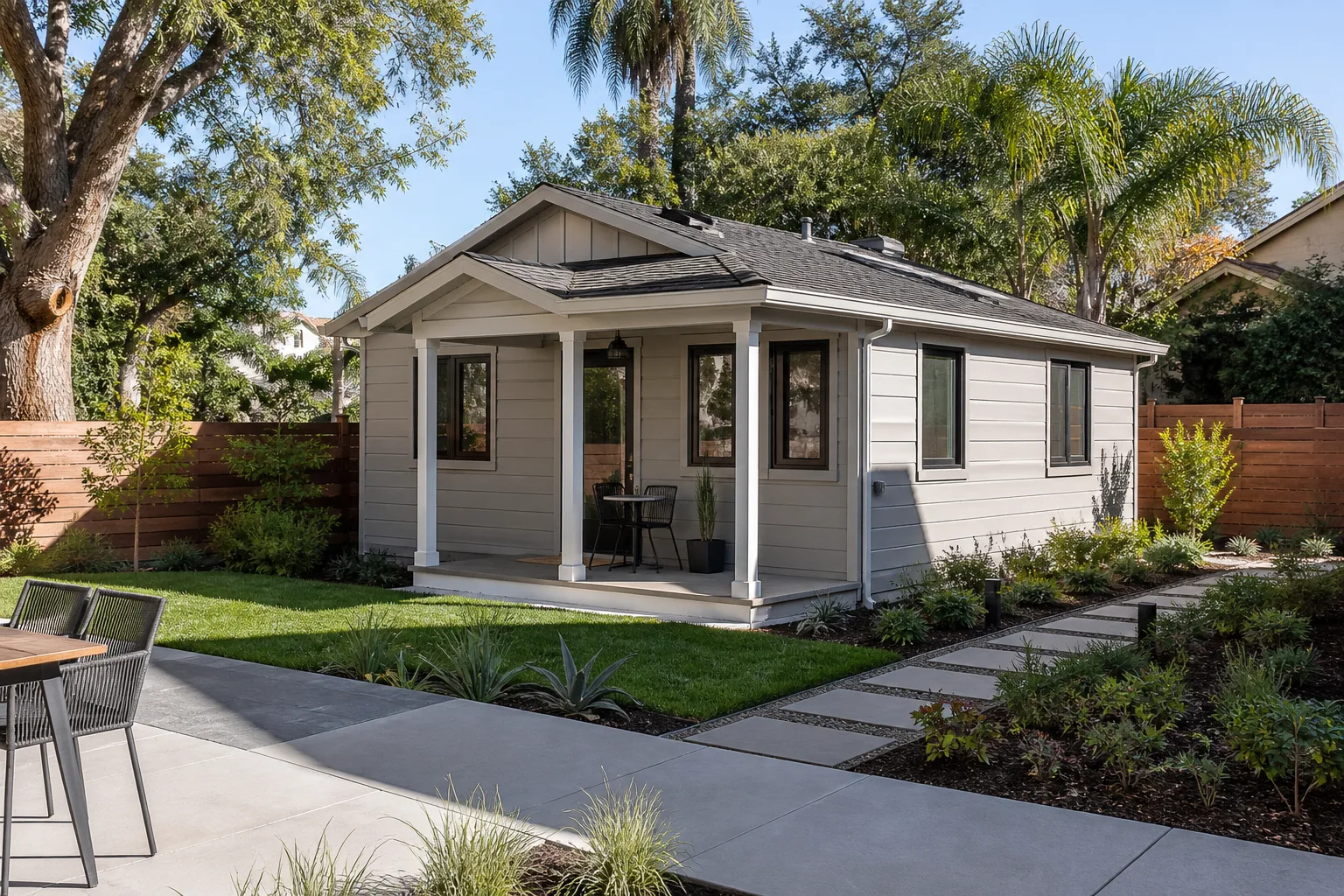
A full Techo-Bloc-integrated home addition or ADU in San Diego falls in the $53,100–$153,400 range, and that spread exists for a reason. A small 400-square-foot ADU with a 200-square-foot paver patio, no retaining wall, and clean site access sits at the low end. A larger addition with structural walls, significant grading, a new driveway connection, and higher-end Techo-Bloc slabs pushes toward the top. Here’s the breakdown that matters:
- Site prep and grading: $5,310–$21,240, depending on slope, soil stability, and access for equipment.
- Foundation and structural work: broader project cost driven by slab size, pier depth, and wall engineering.
- Techo-Bloc paver installation (patio, walkway, driveway section): $4,130–$12,980 for typical addition or ADU footprints.
- Retaining wall construction (if needed): $8,260–$21,240, based on wall height, block type, and geogrid requirements.
- Permits and inspections: we pull every permit and schedule every inspection. The written quote includes this line item, because it’s part of the job, not an add-on surprise.
Every Mason Remodeling Co San Diego project gets a written price before any work starts. Not a verbal ballpark. A written, line-item price. And every completed project carries our 365-Day Done Right Promise: if something isn’t right within a year of completion, we make it right at no cost to you. That includes a free return visit if a repair or installation fails, no dispute process, no conditions.
DIY or Call Us?
Here’s the honest split. You can absolutely inspect your own Techo-Bloc surfaces: look for uneven gaps, standing water, leaning walls, and cracks. Take photos. Measure paver thickness. Check whether the edge restraint is visible or missing. That information helps us give you a faster, tighter quote. What you should not do is start pulling up pavers and re-laying them without understanding what’s underneath. The base is the system, and if the base was bad, a cosmetic paver-level fix lasts six months. Worse, retaining walls carry real load. A failed structural wall can collapse, and that’s not a weekend project; it’s a genuine hazard. If you’re seeing lean or bulge in a wall that holds back more than three feet of soil, call us before it moves further. For anything short of that, we’re happy to walk the site and tell you what actually needs to happen, even if the answer is “not much yet.” Call (619) 673-9302.
FAQs
A properly installed Techo-Bloc paver surface or retaining wall lasts 25–40 years in San Diego’s climate, with the paver surface itself often outlasting the base beneath it. The real variable is the base: compacted, well-drained base material adds decades. A thin base over unamended clay fails within 2–5 years. We’ve torn out 3-year-old paver patios in Clairemont that were sitting on two inches of sand, and we’ve seen 20-year-old driveways in La Mesa that still look set because the base was done right. Call (619) 673-9302 and we’ll tell you which one you have.
Most failing installations can be repaired section by section, and the repair typically costs less than full replacement. The deciding factor is whether the base failed or just the surface shifted. If the base is intact, we pull the affected pavers, re-compact, re-level, and re-lay them. If the base was never built correctly, patching only delays the same problem from reappearing six months later, and a full base rebuild for that section is the honest fix. We’ll show you the difference on site before you commit to anything. Estimates are free: (619) 673-9302.
For the hardscape portion of a home addition or ADU project, expect 1–3 weeks once the structure itself is weathered in and the site is accessible for equipment. A patio and walkway alone takes about a week. Adding a retaining wall extends it by several days depending on height and engineering requirements. We schedule the hardscape phase to not slow down the overall construction timeline, and we coordinate directly with any other trades on site. Call (619) 673-9302 for a timeline specific to your project.
We source Techo-Bloc pavers, wall blocks, and edge restraints directly through our supplier accounts, and we handle the full order, delivery, and installation. We don’t ask homeowners to buy materials themselves; it creates warranty confusion and delivery headaches. Because we install Techo-Bloc regularly alongside other specification-grade brands like KraftMaid, Cambria, and Silestone on larger projects, we’re set up to get the right product, in the right color and thickness, without you having to navigate a masonry supply yard. Call (619) 673-9302 and we’ll work up the material list.
Call (619) 673-9302 to schedule your free estimate. We’ll send a background-checked, uniformed technician whose name and photo you’ll receive before the visit, and you’ll have a written price in hand before any work begins.
Written by Isaac Pruett, Owner, Mason Remodeling Co San Diego at Mason Remodeling Co San Diego, serving San Diego and nearby areas.


